Showing posts with label athletics. Show all posts

Thursday, February 18, 2016

Collegiate Marketing Directors: 3 Action Items to Consider Regarding Social Media Marketing in Athletics


        As an Director of  Collegiate Marketing and clearly a college sports enthusiast, you are well aware of the impact of social media when generating buzz and how effective social media marketing can benefit a department. As a graduate in the Northwestern Medill IMC program and a former student athlete, I have found two articles that address both sides of the spectrum of the effects of marketing on different social platforms.
     
      Julie Blakey's article, “The Intersection of Collegiate Athletics and Social Media” explains the upward trend of social media engagement in collegiate athletics. She details how the ability to connect with passionate fans on platforms like Twitter, Instagram, and Facebook can help develop a community where these collegiate brands can effectively engage fans with hopes of this increasing fan loyalty, with beliefs that this interactivity will produce future returns on investments. She goes on to give great examples of institutions that effectively use social media to help further their fanbase. For example, the Michigan Football Facebook page utilized the ability “like” button to get fans exclusive access to season and individual ticket packages before anyone else, which this sort of buzz pays huge dividends for the university. The University of Oregon has a room called the “Quack Cave.” that is dedicated to monitoring everything Oregon from the coaches, to the players,  and various sports. The approaches from both colleges signify a turn in collegiate marketing that  Julie believes is a win-win if universities continue to effectively utilize social media.


(https://www.pinterest.com/sportsmarketing/collegiate-marketing/)

         In Arash Markasi’s article “Social media is a double edged sword in the sports world,”  he talks about the mindset of young athletes of today and their interactions on different social media platforms. In a study from the Pew Research Center showed that 92% of teenagers are online daily, and 90% of teenagers operate on at least one social media platform. Athletes of today tend to operate with a carefree mentality on these platforms, in which this mindset has had numerous examples of individuals ending up on the wrong end on the court of public opinion. For example, Yuri Wright lost scholarship offers from schools like Michigan and Notre Dame because of his explicit persona on Twitter and multiple BCS football coaches have admitted to social media activity playing a factor in college recruiting as well.  It is sort of tough to be so highly critical of these young athletes because they are young high schoolers and they should make mistakes, but essentially they are future ambassadors of the University as a whole, so that sort of responsibility weighs heavy on the minds of whether or not to offering college scholarships. Overall, it’s a great piece that effectively communicates the importance of being critical of what to post online.

         After reading these two articles and from my graduate studies in the Northwestern Medill IMC program, I have three action items you should consider in your next steps moving forward with utilizing social media, which are:

  •  Get Started: Utilizing every platform may not be necessary at first, so start with one(maybe Twitter first) and figure out an online persona that effectively conveys the desired  image/ message of the athletic department.
  •  Get Educated: Understand that everyone involved in the athletic department is a representation of the University as a whole. Education of social media etitique is a must from faculty to student-athletes to avoid any situations that would disrupt the public image.
  •  Get Noticed: In respect to the image of the University, try to differentiate your university from the rest. Be able to answer these questions. What makes people pledge a sincere allegiance to your university for years to come? How do you want to be perceived by someone who knows nothing about your university?


Hello my name is Deonte Gibson, and I graduated from Northwestern with a BA in Communications and a certificate in Integrated Marketing Communications in June 2015. I am currently enrolled in the IMC graduate program with an open-mind and eagerness to learn about the ever evolving field of marketing communications. The blog was inspired by my career goal to work on the marketing side of collegiate athletics, and how incorporating my knowledge of social media platforms to further marketing success. For more content or just to chat about the ever evolving field of marketing or just about sports, my twitter handle is @deontegib_13!

Monday, May 4, 2015

Athletics Directors: 3 Action Items to Consider Regarding Student-Athlete Compensation

As an Athletic Director and clearly a college sports enthusiast, you have been following the current debate of whether collegiate athletes should be compensated for their athletic abilities. As an undergraduate in the Northwestern Medill Integrated Marketing Communications(IMC) program and a student athlete, I have found two articles that address both sides of the spectrum.


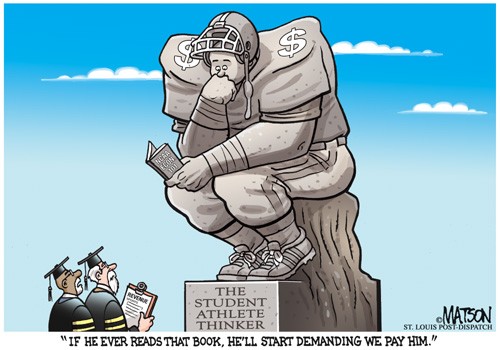
Stephen L. Carter  critically breaks down opposing viewpoints as to why or why not collegiate athletes should be compensated for their athletic abilities in his article titled “College Athletes Need Pay, Not Perks”. He does not necessarily agreed with calling the plight of today’s student athlete an exploitation, but rather the colleges and NCAA are taking advantage of these athletes. Because the NCAA is a nonprofit organization, he compares nonprofit employees to collegiate athletes. Now although these workers receive a lesser form of payment, they actually get something financially out of the deal unlike the athletes. He also makes it known that disregarding the benefits of free tuition, room and board, and an opportunity to play at the next level should not be minimize as part of what the university offers. It is a very interesting viewpoint of the student-athlete v. the NCAA saga.


http://silkroadsandsiamesesmiles.com/2012/10/24/the-true-origin-of-the-term-student-athlete/
In Jake Novak’s article “Paying College Athletes will Ruin the Game,”  he explains why paying collegiate athletes is not wrong because they may deserve to be paid, but rather the value of collegiate athletics would begin to diminish in the long run. In the article, the author states that of the wealthier 50 and over males surveyed, 32% of them said they would stop following collegiate sports if the athletes were compensated. Given this demographic is not representative of society as a whole, but it is an interesting effect of what would happen if the student-athletes are paid in the future. It’s this allegiance to one’s alma mater that makes the backing of collegiate athletics so strong, and without that backing then the entire industry would slowly begin to crumble. Another interesting take on a controversial subject, especially since it plays on this idea of passion communities v. trigger ones. Events that would qualify as trigger ones would include O’Bannon v. NCAA and the unionization of the Northwestern Football Players. The passion communities are people in the blogs that represent themselves as college-purists, and would dare not to see this level of sports turn into a professional like showcase.


After reading these two articles and from my undergraduate studies in the Northwestern Medill IMC program, I have three action items you should consider in your next steps moving forward with your student-athletes, which are:

  • Educate Them: These student-athletes took a huge leap of faith when deciding to come to your university believing that you would do whatever is in your power to lead them down a successful path, so make it happen. I am not saying to just hold their hands and do everything for them, but encourage them to diversify their course schedule, to take career treks, and expose them to professions that compliment their strengths.
  • Monitor/Protect Them: Periodically check in with them via surveys or set up appointments where they openly express how beneficial the athletic department has been to them. Ensure that their safety on and off the playing field is a priority as well.
  • Challenge Them: Dare them to be great in every sense of the student-athlete concept.
     
  Going into my fifth year as a Northwestern University student-athlete, I see that our department has made strides in creating the most beneficial experience, which I am truly grateful for.  I also believe that making sure the student-athletes graduate with a degree that will benefit them in the real world and ensuring that they are taken care of medically are the most important issues at hand in the world of collegiate athletics today.


Hello my name is Deonte Gibson, and I am a graduating senior from Northwestern University with a BA in Communications with a certificate in Integrated Marketing Communications. In the fall of 2015, I will be enrolled in the IMC graduate program out of Medill with an open-mind and eagerness to learn about such an exciting field. The blog was inspired by my career goal to work on the marketing side of collegiate athletics, and how the pay for play phenomenon could potentially change the landscape of collegiate athletics marketing. For more content or just to chat about the ever evolving field of marketing or just about sports, my twitter handle is @deontegib_13!

Wednesday, May 16, 2012

Important Marketing Lessons from the Ill-Fated Jabulani


By: Mike Logan

(Image from http://espaciodeportes.com)

    On December 4th, 2009, German Sporting goods and apparel company Adidas announced the release of the official ball for the 2010 World Cup: The Jabulani. Jabulani, adapted from the isiZulu word meaning ‘to celebrate,’ unbeknownst to Adidas, would leave them with little celebrate; however, the PR firestorm that followed taught Adidas, and the rest of the sporting world, a great deal about how to manage unexpected events and how to prevent them in the future.

  • Involve players, the key stakeholders, more deeply in the development of the product.
  • Don't develop your products in a vacuum. Complicate designs and make sure you are prepared to handle worst-case scenarios.
  • There should be no 'business-as-usual' issues for an organization. Handle small issues with swiftness and urgency, especially when your brand image is on the line.


     When goalies and strikers alike began complaining about the flight pattern and unpredictability of the Jabulani, Adidas simply shrugged off the issue and chalked it up to ‘business as usual,’ remarking that complaints arise before every World Cup as a result of unfamiliarity with new equipment. By ensuring that players, the customers on the frontlines, are involved in the testing and development of important new products like the Jabulani ball, Adidas and other sporting-goods providers can better protect themselves from negative press from product defects and errant complaints. Adidas has learned from this mistake and is testing their new products with professionals and amateurs to gather immediate feedback for product tweaks. As David Stern of the NBA once remarked, “Although testing [by Spalding] demonstrated the new composite basketball was more consistent than leather and statistically there has been and improvement…the most important statistic is the view of our players.”

     Product developers can further protect themselves by refusing to oversimplify designs and testing procedures. By accounting for the dynamic and unpredictable nature of field conditions rather than a product’s usefulness in a vacuum, producers will ensure that they have the most complete and well-tested product possible. Unfortunately, in sports, human error and subjectivity are incredibly important variables and should not be removed entirely from the equation. Though the Jabulani was the most spherical ball ever created, its unpredictability under play-conditions had not yet been accounted for before it was released on one of the greatest international stages in sports.

     Finally, Adidas failed to recognize the complaints of the players as a symptom of systemic distress rather than a common hurdle that has to be dealt with every four years. All organizations, dealing with sporting goods or otherwise, should be poised to respond to signals such as this swiftly and strongly rather than gambling and letting the issue grow into a much larger problem. 

    Adidas has clearly learned from this issue and is deftly moving forward in product R&D and crisis management. Every organization should be able to take these well-documented lessons and manage both the development of their products and crisis communications more adeptly.

Mike Logan is an M.S. candidate at Northwestern's Medill school for Integrated Marketing Communications. Follow @MikeAKAMaverick or connect at http://www.linkedin.com/in/mikeplogan.