Showing posts with label "McKinsey". Show all posts

Wednesday, May 13, 2015

CMOs: 3 Steps Your Company Should Follow Facing Big Data Era


“Big data is like teenage sex: everyone talks about it, nobody really knows how to do it.” This is a famous post said by Dan Ariely in January 2013. I deleted the latter part of the original sentence - “Everyone thinks everyone else is doing it, so everyone claims they are doing it.” - Because I think after two years exploration, it’s not really the case now in 2015.


It’s true that there are still a lot of companies don’t know how to do it. But I do see a fair amount of companies are properly using big data and making brilliant business decisions based on it. As a master student in Integrated Marketing Communications, specialized in data analytics, I found two articles that provided a wholesome picture on what companies should do in the inevitable big data era.


Brad Brown, director of McKinsey's New York office, shared in the article Views from the Front Lines of the Data-Analytics Revolution that the most cutting-edge views from the most experienced executives from the leading companies which are adept in data analytics field. They addressed the opportunities as well as the underlying problems companies are facing. They also provided suggestions concerning the effort companies should make both internally and externally.


Matt Ariker, the chief operating officer of McKinsey's Consumer Marketing Analytics Center, discussed in the article How to Get the Most from Data that what kind of talents you need to help accomplish the challenges mentioned above. Depending on the nature of your business, you would emphasize on different human resources. If your company relies heavily on data and technology, say Amazon, you may want to focus your effort on hunting for data scientists who can build reliable models and optimize the algorithm system. However if your company is a consulting firm which provide business strategy for clients, you may want to find someone has both analytics and business background to understand the business environment supported by solid quantitative evidence.
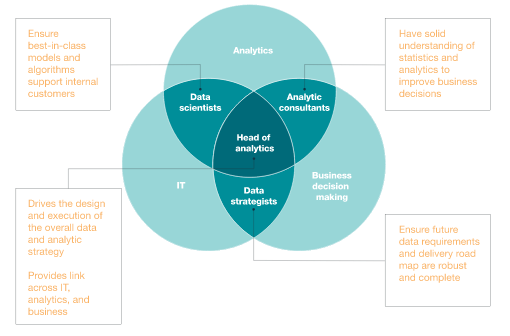

Based with my experiences in data analytics field, I would like to suggest three calls to actions for CMOs who already have a sense of urgency concerning data analytics but don’t have a clear path in mind:
  1. Arm your company with data analytics talents. Translating the data from nonsense to valuable insights require adept skills in manipulating data as well as strategic mindset of incorporating data into business context. The intersected talents in both areas will lead your company to a prosper future.
  2. Clearly define your data analytics strategy. Simply collecting data will not enable you to unleash its potential value. As companies are developing their media strategy, content strategy and so forth, it is wise to take into account data analytics strategy as well. Without a strategic approach of digesting BIG data, you’ll be overwhelmed as opposed to have a clear clue about what’s going on.
  3. Get the most out of data to optimize your business decisions. Through these actions, you will possibly secure a static spot in the stormy red ocean.



Ci Yuchian had 2-year experience in Social Marketing and Public Relations. Now she's majoring in Integrated Marketing Communication at Northwestern University. She has a focus in data analytics as well as hands-on experience in entrepreneurship of analytics field.

Contact her through Twitter @Yuchian_Ci or LinkedIn

Wednesday, May 7, 2014

Luxury Marketers: Big Data from the boutique? New technologies help best serve your customers

  
Digital is radically changing the consumption pattern of luxury goods consumption in every way. As a graduate student studying the Integrated Marketing Communications in Northwestern University, I’ve always been interested in learning the marketing trends within luxury and how the industry would leverage technology as well as digitalization to make the best outcome. For those luxury managers who are poised to offer top-tier services as their merchandise, here I found two inspiring articles that would help you make it happen.

According to a recent report from McKinsey (see "Digital luxury experience: Keeping up with changing customers" by Linda Dauriz), the future of digital luxury hasn’t been bright ever — online luxury sales are growing twice as fast as the overall market. The report demonstrates that, in 2013, digital interactions directly generated more than 13% of offline luxury sales and influenced another 28% of sales. Also it shows that more than 45% of luxury purchases are influenced by what shoppers find in the digital universe. From all these mind-blowing numbers we can obviously feel the power of digitalization in terms of boosting luxury sales in today’s world. But, what’s more noteworthy is that although pure online transactions are growing twice as fast as the sector as a whole, they represent only about 4% of the total luxury goods market. Shoppers use the digital platform more for search and comparing purposes rather than making purchase — especially for luxury consumers who are going for more expensive or custom products. However, engaging, easy-to-navigate mobile platforms would play an important role to drive store traffic to the physical boutiques, since shoppers are more likely to use smartphones for commuting info (shopping or dining). More than half of their searches of products are on mobile devices, and by the time they actually enter the store, they’ve already gathered detailed information about the products they’re about to purchase.


Another way that digitalization could help in in-store sales is through in-store facial recognition. The article Big Data is Watchingby Sophie Doran has introduced the state-of-the-art method of tracking in-store consumer data by following wi-fi signals and by using surveillance softwares to profile customers. As the article elaborates, Nordstrom’s experiment used video surveillance and signals from shoppers’ cellphones and apps to learn information as varied as their sex, how many minutes they spend in various parts of the store and how long they look at merchandise before buying it. Moreover such detailed info would be stored permanently and activate globally through the facial recognition tools. All the data gathered from this “in-store monitoring”, combined with data gathered from digital platform, can provide marketers valuable information about customer preferences so as to guide them to change store layouts and offering more customized services, creating ever satisfying in-store customer experience throughout the world. However, the legal issue has been brought up with it, suspending the experiments in Nordstrom after months. Generally in customers’ minds, personal data is the price they pay online for the ability to quickly compare pricing and arrange convenient delivery. Whereas they feel that this “give to get” mechanism won’t apply when it comes to in-store data collection — When retailers try and collect similar data from consumers in a physical retail environment, they become unnerved, with the key criticism of in-store data collection being lack of consent.

In reading the above 2 articles, I would suggest 3 actions for luxury marketers regarding how to best leverage big data to stay at the cutting edge and generate higher revenue benefited from what you have:
  
    1. Perfect in-store experience & use digital as catalyst. Digital is serving more as the helper for customers to purchase wisely, but boutiques are still where they make purchases. Deeper engagement with customers digitally, however, can increase store traffic to generate higher revenue.

     2. See the value of in-store data. The value of In-store experience for customers determines the value of monitor in-store behaviors for marketers. Combine in-store data with online transaction, marketers can profile best-valued customers more accurately and offer them more satisfying purchase experience.

     3. Never overlook the legitimacy of data collection. The dispute over the legitimacy of gathering user data is more serious than ever. Complaints and criticism around “big data or big brother” have been and will still be the topic. Therefore, marketers have to notify customers before getting any access to data in order to keep away from troubles.


The luxury market is seen as the most passion-driven and customized market. The nature of the industry has already revealed its close relationship with advanced data analysis. As the new technology popularizes in application, the deeper than ever understanding of each customer would open a brand new page in terms of building customer-brand relationship, and thus create a much more efficient business model to generate a win-win situation for both brands and customers. Let’s look forward to it.


Cerise Miao is an MS candidate in Integrated Marketing Communications at Northwestern University, majoring in marketing analytics and brand strategy. Majored in economics in college, she is interested in music, movies, languages and fine arts. She has passion for luxury and for data analysis. 
Follow Cerise @CeriseMiao