Showing posts with label "Big Data" "Northwestern". Show all posts

Wednesday, November 18, 2015

3 ways the programmatic industry can become customer-centric

As the CEO of a programmatic technology company, you know that the industry is constantly changing and the decisions you make must address that change. As a student in the Northwestern Medill Integrated Marketing Communications program, former strategic planner and former consultant to a programmatic company, I have found two articles which provide helpful insights on how your programmatic company can become customer-centric and help your team rise to the top.


This Mediapost article explains how the programmatic industry struggles to be customer-centric because of the lack of understanding of the technology itself – a knowledge gap, from an internal agency & advertiser stand point. It brings to the table, concerns of how the industry will carry on selling something when it is not completely understood. Another article from MarketingTech also touches upon how the lack of knowledge of the technology might result into lack of confidence in technology and mistrust over transparency from a customer’s perspective. Thus, the root problem for the industry still lies in the fact that there is a huge knowledge gap that needs to be corrected if the industry wants to achieve sustainable growth.

Based on the problems identified, the industry needs to focus on being customer-centric in order to bridge the knowledge gap and help the customer build more confidence in the technology itself. Through my experience at Northwestern University and IMC, I recommend these three tips to become customer-centric and bridge the knowledge gap for customers:
  • Training programs for customers- Training programs will be a great medium to connect with customers; they will ensure that the company can have open conversations with your customers about the challenges they face with the technology. It will not just help educate but will also help the product team understand problems from the customer's perspective.
  • Customers are experts- The idea is also to make customers feel like they are experts in order to make them even more confident about their investments in programmatic buying.
  • Avoid jargon- It is essential that the content and collateral that the programmatic company produces, makes the complexities of the engineering technology simple. The tonality of the content should be simple and easy to understand for the customers.
Thus, if a programmatic company wants sustainable growth, the first thing it needs to do is become customer-centric and reduce the knowledge that exists internally and externally. Companies which can successfully reduce the knowledge gap, will be the ones who succeed and will gain customer's trust. 


Isha Deodhar is an experienced data-driven marketing and strategy professional with over three years of industry experience in Consumer Products & B2B Technology Strategy. She has a Master's in Integrated Marketing Communications from Northwestern University as well as a Master's in Economics. You can follow her on @ishadeodhar on Twitter and Linkedin.

Wednesday, May 13, 2015

CMOs: 3 Steps Your Company Should Follow Facing Big Data Era


“Big data is like teenage sex: everyone talks about it, nobody really knows how to do it.” This is a famous post said by Dan Ariely in January 2013. I deleted the latter part of the original sentence - “Everyone thinks everyone else is doing it, so everyone claims they are doing it.” - Because I think after two years exploration, it’s not really the case now in 2015.


It’s true that there are still a lot of companies don’t know how to do it. But I do see a fair amount of companies are properly using big data and making brilliant business decisions based on it. As a master student in Integrated Marketing Communications, specialized in data analytics, I found two articles that provided a wholesome picture on what companies should do in the inevitable big data era.


Brad Brown, director of McKinsey's New York office, shared in the article Views from the Front Lines of the Data-Analytics Revolution that the most cutting-edge views from the most experienced executives from the leading companies which are adept in data analytics field. They addressed the opportunities as well as the underlying problems companies are facing. They also provided suggestions concerning the effort companies should make both internally and externally.


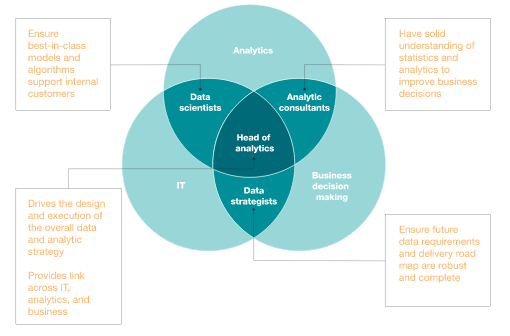
Matt Ariker, the chief operating officer of McKinsey's Consumer Marketing Analytics Center, discussed in the article How to Get the Most from Data that what kind of talents you need to help accomplish the challenges mentioned above. Depending on the nature of your business, you would emphasize on different human resources. If your company relies heavily on data and technology, say Amazon, you may want to focus your effort on hunting for data scientists who can build reliable models and optimize the algorithm system. However if your company is a consulting firm which provide business strategy for clients, you may want to find someone has both analytics and business background to understand the business environment supported by solid quantitative evidence.


Based with my experiences in data analytics field, I would like to suggest three calls to actions for CMOs who already have a sense of urgency concerning data analytics but don’t have a clear path in mind:
  1. Arm your company with data analytics talents. Translating the data from nonsense to valuable insights require adept skills in manipulating data as well as strategic mindset of incorporating data into business context. The intersected talents in both areas will lead your company to a prosper future.
  2. Clearly define your data analytics strategy. Simply collecting data will not enable you to unleash its potential value. As companies are developing their media strategy, content strategy and so forth, it is wise to take into account data analytics strategy as well. Without a strategic approach of digesting BIG data, you’ll be overwhelmed as opposed to have a clear clue about what’s going on.
  3. Get the most out of data to optimize your business decisions. Through these actions, you will possibly secure a static spot in the stormy red ocean.


Ci Yuchian had 2-year experience in Social Marketing and Public Relations. Now she's majoring in Integrated Marketing Communication at Northwestern University. She has a focus in data analytics as well as hands-on experience in entrepreneurship of analytics field.

Contact her through Twitter @Yuchian_Ci or LinkedIn