Showing posts with label CPG. Show all posts

Monday, November 10, 2014

Shopper Marketers: Understand the Data Today or Lose the Market Tomorrow

Today shopping has transformed into an omni-channel experience integrating online to offline at multiple touch points. As a graduate student in Northwestern University's Integrated Marketing Communications (IMC) focusing on marketing analytics,   I have found the following two articles insightful for shopper marketers. They respectively explain the big data utilization in shopper marketing and precision marketing analytics.

“Big data is a journey that every company must take to close the gap between the data that’s available to them, and the business insights they’re deriving from that data.” quoted from the article Shopper Marketing Filling the Cart with Big Data which draws the line form  Lisa Klauser , president of shopper marketing at IN Marketing Services. According to the article, the integration of online activities and offline in-store shopping experiences creates tons of opportunities for brick-and-mortar marketers to track and measure the shoppers in more aspects than ever. By collecting and connecting more data variables together, marketers can more precisely detect the causality. Tracking the patterns in data is almost like keeping abreast of millions consumers from their online engagement to their offline purchase journey, while linking the patterns together could even lead to a map of specific decision-making process of each target segments. More importantly, technology enables marketers to track individual shoppers and connect multiple devices to in-store shopping. In other words, understanding data would help us to unveil the real identity of the consumers, estimate consumer lifetime value and take immediate actions.
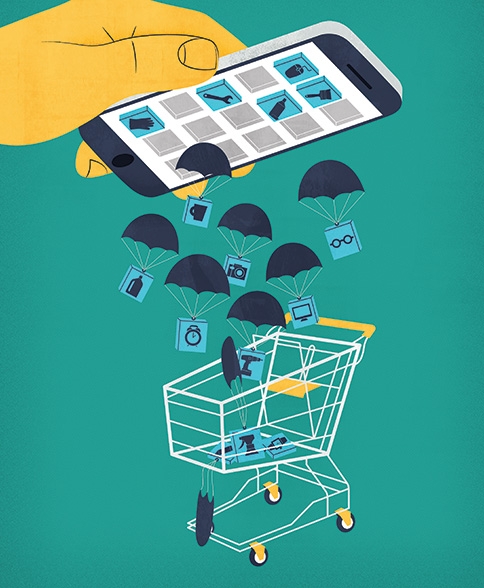
                                      Illustration: Mitch Blunt
Source:http://www.adweek.com/sa-article/shopper-marketing-filling-cart-big-data-158332 

More often than not, marketers use constant parameters regression (CPR) modeling to estimate advertising effectiveness, which is acceptable in revealing an overall effect which has been averaged out over time and different instance. In the article Precision Marketing Analytics: Working withTime-Varying Parameters from Accenture, the author compares the CPR modeling with the more advanced time-varying parameters (TVP) modeling. TVP modeling is able to discriminate the actual difference in advertising effectiveness at a granular level over time. Thus, it allows marketers to measure the real ROI of certain marketing activity separated from other actions across the time. As the example of a fictional FCMG company given in the article, using TVP model can especially help retailers and CPG brands attribute marketing efforts to real sales in a more accountable way considering the seasonality, geographic differences and other factors resulting in the volatility of this industry.

Connecting these two articles with my studies of marketing analytics at Northwestern, there are three actions you should consider in your next analytics project. They are as following:

1.     Leap to insights - This not only requires the analyst to carefully examine the availability and quality of data, but also put the analysis in certain context and even from a personalized perspective. The leap from data to insights is usually propelled by finding the connections between consumers’ wills and their actual behaviors.
2.     Deal with complexity. Simply average out the effect in analytics is dangerous in terms of both precise prediction and appropriate interpretation. Including time varying parameters is vital for marketers to discover the real unusual patterns.
3.     Anchor analytics to strategy. Actually, the most effective marketing analytics is an eco-system creating the self-sufficient circle from data collection, personalized interaction with consumers through multiple channels, to measuring marketing effectiveness.

The transformation that is taking place in the CPG and retail industry is just as fast as the increase of data everyday. Always being innovative and analytical, professionals in shopper marketing would never let go of such a great opportunity of boosting their business to another level with data.


Amy Zhou is a marketing analyst who has experience in formulating stories for several CPG and retail brands through data analytics and market research. She is now pursuing her masters’ degree majoring in IMC at Medill Northwestern, with the concentrations in marketing analytics and digital marketing. She is strongly interested in work opportunities in related areas.

Connect with her on LinkedIn or Twitter @Amy__Zhou.

Wednesday, May 7, 2014

Retailers - How Can You Survive and Thrive in Today’s Omni-channel World?

Today, brick-and-mortar is being challenged by online channels and consumers want a seamless blend of both. As a graduate student in the Integrated Marketing Communication (IMC) program at Medill, Northwestern University, I am dedicated towards shopper marketing insights and digital analytics. During my research on omni-channel retailing, I identified the following two articles that will help clear retailers’ concerns about the negative outlook on the future of the retail stores and provide valuable tips on the success of today’s retailers.  
Marci Weisler, COO at EachScape Inc. and an influential strategist in digital and online businesses, discusses The Future of Onmi-channel Retail. In her article, she argues that onmi-channel in fact presents a huge opportunity for retailers although challenges accompany. She believes that retailers should leverage the multi-device landscape, integrate CRM information system and adopt other strategies such as Geofencing in order to provide customers with consistent delightful experience. However, developing seamless customer experience requires high level of cooperation and consistent planning across divisions of the company, which remains a challenge for a lot of retailers.

In ATKearney’s recent report of Recasting the Retail Store in Today's Omnichannel World, evidence suggests that consumers value the retail store experience on multiple levels and continue to make the vast majority of their purchases in stores. However, the shift to an omnichannel shopping experience means the value of physical stores' traditional role has changed. Stores, on their own, have become less productive and profitable. In order to remain retail stores at the heart of the customer relationship, retailers need to reconsider a retail store’s new role to address evolving needs and behavior by making the retail store a place for discovery, entertainment and personalized experience development.
Based on my analysis of the above two articles and other retail-related research that I have completed,  here are the three action items that retailers need to consider in order to thrive, not only survive, in today’s omni-channel world.

1.      Integrate multi-device landscape and stay consistent across channels - By connecting the customer across web, mobile, and in-store, more purchases will be driven through ease of use. Tactics such as staying consistent across channels as well as coordinated cross-channel promotions will help consumers stay loyal to a brand, and stores will gain higher customer satisfaction rates.
2.      Leverage store formats - By developing a strategic portfolio of store formats, the future of the retail stores should be able to include the discovery and entertainment elements, facilitate well-executed transactions, build strong customer relationship, and provide efficient fulfilment of online purchases.
3.      Improve retail operations system – By implementing omni-channel solutions, such as ship-from-store, in-store pickup and in-store associate ordering will give consumers the type of retail service they expect both online and offline, and help retailers to drive sales in-store.
Remember, customers have redefined commerce, requiring retailers to respond with more choices, convenience and seamless shopping experience.  Get ready and thrive in this onmi-channel world.

Christy He is pursuing her Master of Science in Integrated Marketing Communication (IMC) at Northwestern University, with an emphasis on marketing analytics, shopper marketing insights and digital marketing. She previously provided retail measurement and developed retail strategies for major CPG and retail companies at Nielsen. She hopes to continue her professional career post-graduation to focus on data analytics and shopper marketing in the fields of retail, CPG and e-commerce.
Follow her on Twitter @christy_he or contact her via LinkedIn

Monday, May 5, 2014

Package Goods Marketers - Go Digital or Perish

Although e-commerce is no longer a new word and it has greatly changed people’s shopping behaviors, consumer packaged goods manufacturers and retailers may have underestimate the market opportunities there. As a graduate student in Medill’s Integrated Marketing Communication program, with concentration on marketing analytics, I have been looking at potential opportunities and future trends for consumer packaged goods companies. Recently I found 2 informative articles on digital commerce opportunities for consumer packaged goods companies. 

In the article Digital Commerce Remains a Largely Untapped Opportunity for Consumer Packaged Goods Companies, Deloitte talks about its two surveys on CPG industry executives and senior managers as well as on consumers. The results show that consumer’s intent to purchase these products online far outpaced executives’ expectations and CPG companies are obviously not well prepared. Moreover, surprisingly, only 43 percent of CPG executives think their company has a clear, well-understood digital commerce strategy. Pat Conroy, vice chairman, Deloitte LLP and consumer products sector leader, concludes that CPG companies are not well prepared enough for consumers’ changing behavior and data suggests that they should develop a more comprehensive strategy in order to take full advantage of this growing opportunity. 


In the article E-Commerce: It’s an Evolution, Not a Revolution, Nielsen also mentions that although E-commerce enables CPG manufacturers and retailers to engage shoppers in more ways and create more values for shoppers through online models CPG manufacturers and retailers have not capitalized such opportunities as well as other categories. The article points out that consumer engagement is greatly increased because much more touch points, such as websites, emails are social media, are available for online shoppers. Therefore, it is important for CPG manufacturers and retailers to understand what these shoppers are looking for in order to create more value to them and build stronger relationships with them.


Based on the reviews of these two articles and my knowledge and experience, there are three principles CMOs of CPG companies may apply in order to help their companies succeed in the evolving digital commerce world.

1. Create a Digital Commerce Strategy - Be prepared for the evolution and develop comprehensive digital strategy for digital commerce. The first step for companies is to create a clear and well-rounded digital commerce strategy. 

2. Understand the Potential Online Shoppers - It is crucial for CPG companies to understand what benefits online shoppers are looking for and what added value they can provide for shoppers.

3. Increase Engagement and Create Values for Long-term Relationship - E-commerce make it possible to reach consumers almost any time. Marketers can leverage on that to improve brand awareness, drive product initial purchase, increase repeat purchase and reconnect with lapsed consumers.

Digital commerce provides CPG retailers and manufacturers more opportunities to directly communicate with customers, which means that marketers are now able to influence off-line decisions as well. Digital commerce no doubt has its unique benefits and as technology develops it will only becomes more and more important. Therefore, by developing a more sophisticated digital strategy based on understanding potential customer behavior, CPG marketers can maintain long-term stronger customer relationship and in the end take advantage of the opportunity.


Happy Chen is pursuing her master degree in Integrated Marketing Communications at Northwestern University, with a focus on marketing analytics and digital analytics. With previous working experience in consumer packaged goods industry, she is also a number lover, Excel junkie and SAS programmer. Questions or Comments?  Contact me on LinkedIn or Twitter @Happy_CHP .

Thursday, October 24, 2013

Brand Success = Customer Focus + Brand Essence


With consumers becoming less brand loyal, it is more important now that brands understand their consumers and what the consumers believe those brands mean to them. Sadly, the day when a brand was able to determine its meaning has passed, making it important to understand why consumers use a given brand. In these examples, Hershey an Absolut, they demonstrate what happens when a brand understands how it fits into its consumer’s world and what consumers relate to and continue to buy said brand. These examples provide lessons for other brands to follow not by trying to be everything for everyone, but rather understanding what they are for those who want them and where they started.


How Hershey Brand Got Its Start in China –But Don’t Call It an Import” by E.J. Schultz, shows how for the first time, Hershey launched a new product, a new type of caramel candies, first in China before the United States. The composition of these candies show the research and understanding that went into the creation of these candies while demonstrating that Hershey understands the important differences between the United States candies and the China candies, along with the different consumers. By creating these products concurrently, Hershey focused on gaining efficiencies through selling these products. Additionally, these products exist in different categories in each country; in China they fall into the “milk candy” category, whereas in the United States they are more traditionally caramels.
 “Absolut’s Iconic Bottle Is Its Ticket toYounger Consumers: Staying competitive in a market flooded with new spirits” by Joan Voight: since 1986, the Absolut bottle shape has remained consistent and been a place for artists to test out their art. While there are certain aspects about Absolut that keep it from being a craft vodka, by maintaining its deep connection to the artistic community and the care with which it fills every bottle, Absolut knows how to keep its loyal consumers returning time and time again.
Based on my work at the Medill program and analysis of these articles, these are three things that you need to do:
  1.  Understand what your brand means to others – this is different from understanding what the brand meaning/promise is, rather it is looking at the brand through the lens of the consumer. Ask your consumer what your brands meant to them and why they bought it. (Look at how Hershey understood what different markets wanted from seemingly similar products).
  2. Conduct market research – use this to determine who your consumers are and how your brand connects to them. (Look at how Absolut connects with its artist community)
  3. Find a path to follow and stay with it – do not be afraid to stick with what made you famous (i.e. Absolut and its iconic bottle along with its connection to the artistic community) or pick a new path and fully embrace it (Hershey's dual product launch).     
In a time when competition within the food and alcohol industry is fierce, the brands are showing how they can continue to innovate based on their understanding of their product, brand and consumer. These examples show brand managers and marketers what they need to best understand about their product, especially in the food and alcohol/spirits industries, to maximize acceptance and maintain a position in its consumer circle. To say relevant and front of mind with consumers, it is necessary to follow these steps as these are examples of how Hershey and Absolut have remained connected to their consumers and strong contenders in their markets.

    ·      Marti Lauer is a graduate Integrated Marketing Communications (IMC) student at Northwestern University’s Medill School. Her interests lie in the food and beverage industry and CPG along with understanding how consumer experiences and insights shape attitudes and actions. She can be reached at @MartiLauer on Twitter

    Image: http://georgeteiosanu.ro/tag/studiu-de-caz/