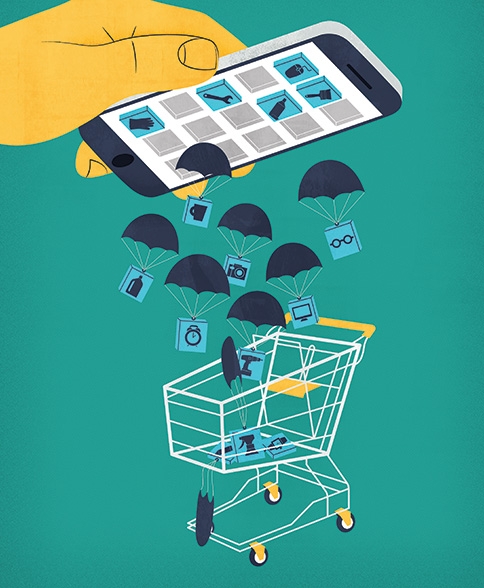
Building a digitally
enhanced, omni-channel customer experience amid today’s rapidly evolving
technologies is like trying to change a tire on a car as it speeds down the
road. The deluge of data available from online interactions and increased
mobile technology adoption by consumers demands that in-store retail must
become dramatically nimble and integrated with its digital counterpart. As a
graduate student in Integrated
Marketing Communications at Northwestern University, my research has been driven by an
interest in mass market retail. I am always on the lookout for ways that
retailers can sculpt the in-store customer experience and drive loyalty using
analytics and new technologies.
Disruption: The Internet of Things
In Leveraging The Internet Of Things And Supply Chain Intelligence To Drive Superior Customer Experiences, Simon Walker reveals that many retailers are employing a growing network of physical objects called the Internet of Things (IoT). These objects contain embedded technology that allows them to communicate with each other to |
| Some predict that the Internet of Things will ignite a fourth industrial revolution, becoming a $200 billion global industry by 2020. |
Retailer’s Advantage
Inventory becomes
seamless. IoT technologies track in-store items so that when something is sold,
an RFID chip sends a request to replenish it on the store shelves. Item sales
can be tracked in real-time to give buyers a more accurate picture of what is
selling well and what is not. The chips also give salespeople and customers
insight into availability of similar items in other locations.
Disruption: Wearable Devices
Connected to the IoT will be wearable devices. More than ⅔ of all consumers plan to buy connected technology for their homes by 2019, and nearly half say the same for wearable technology. (Source: CMO.com) Walker explains that wearable devices are forecasted to become so significant that each person’s smartphone will become a hub for their own Personal Area Network (PAN) consisting of wearable gadgets such as health sensors, smart watches & jewelry and sensors embedded in apparel. Wearable devices will communicate with apps on the smartphone in the PAN, as well as other in-store sensors, to provide details on the consumer so intricate that retailers may be able to predict what consumers want to buy without before they even know they need it.Retailer’s Advantage
Retailers can use
information from wearable devices to gain a complete view of the customer
journey. Technology in a consumer’s alarm could connect with the coffee maker
to start brewing coffee before he awakes, and if the coffee supply is low,
technology could contact the grocery retailer to deliver more coffee by the
time he returns home from work. With such detailed insight, consumers will soon
not even have to think about when to purchase.
Disruption: In-store WiFi
Customer loyalty will be won by retailers who embrace how and when the consumer wants to do business. 68% of today’s connected consumers use a mobile device inside a store. This changes the definition of how a retail store operates and how it must engage with them. In How Retailers are Using Big Data to Deliver Greater Customer Insight, Andy McCue reveals that in the past, retailers not only have not provided WiFi service, but some have even blocked it inside their stores to avoid “showrooming” practices where consumers locate items of interest but then price shop online to purchase at a lower price. But providing free WiFi to customers can actually benefit retailers.Retailer’s Advantage
Using a
mobile app or a mobile-enabled website while inside the store, customers can
scan barcodes to order home delivery, read product reviews and broadcast images
to friends to ask for their opinions. The most compelling benefit of in-store
WiFi is that personal customer data can be collected as shoppers log on inside
the store. With this information, retailers can analyze how frequently shoppers
visit stores and gather mobile browsing behavior and specific demographics
information. McCue mentions that some research even shows that stores who
advertise free in-store WiFi can influence consumers to shop there instead.
 |
| Tesco innovation is a virtual store built in a subway in South Korea where commuters can use mobile phones to order goods from a wall of products. |
Disruption: Big Data
Brick-and-mortar retailers who also maintain an ecommerce store have an advantage over online-only retailers. As large retailers begin to bridge data from in-store transactions and online interactions, this combination will give them a significant advantage over digital retail. In his article McCue asserts that big data metrics are necessary to facilitate individualized shopping experiences. Consumers with less time and more technology want instant rewards, and they want to build relationships with brands over multiple channels.Retailer’s Advantage
Retailers
can analyze this massive deluge of data to precisely target customers,
improving operational and promotional efficiencies. They can isolate specific
customer segments and use predictive analytics to identify trends such as timing of shopping trips and
product preferences. This allows them to personalize shopping and even
pair this knowledge with new beacon technology to engage customers early and
secure their loyalty, sometimes even before they walk in the door.
Disruption: Beacons & Geofencing
The combination of location sensing devices and mobile apps opens the door for a whole new generation of personalized customer service and marketing communications. McCue continues his discussion with beacons, wireless sensors that use Bluetooth Low Energy (BLE) technology to communicate with and send data to smartphones within a given distance. Geofencing uses the location data in smartphones so that, for example, when a customer gets within a certain distance of a store, their phone alerts them that they have received an offer for that store.Retailer’s Advantage
Beacons
have many uses, from directing customers to the location of items they are
shopping for, to delivering discounts in real-time. Beacons can also be used to
make mobile payments, speeding up the checkout process. Beacons collect
consumer data as well.
In 2012
a Guatemalan shoe retailer won the Cannes Lion award for a gamification app
that used geofencing to poach shoppers from nearby competitors. When a shopper
walked into a rival store, the Meat Pack Hijack app would take over the screen
with a countdown that started with a 98% discount that dropped by 1% every
second that it took the shopper to get to the Meat Pack store. The app
automatically froze the countdown as soon as the shopper crossed the store threshold.
One shopper received a whopping 89% discount on his shoes when he was able to
run to the store in 9 seconds.
What can you do today that will help you prepare to leverage and manage these impending market disruptions?
2 – Get proactive, pull
out your hypothetical spatula and flip any fears around negative feedback into
a focus on consumer needs. Soon traditional B2B and B2C approaches will become
dated in comparison to a more personalized and self-directed
Business-to-Individual (B2i) approach. Retailers must look at every customer
touchpoint - both in-store and online - as an opportunity to start a relevant, two-way
conversation with the customer. Understand howthe purchase process looks
from the customer’s perspective. Map out the purchase cycle from the customer’s
point of view, and get feedback from the customer to guide you.
3 – Develop a
long-range plan for how you will manage data to personalize the shopping
experience. Keep an open mind and subscribe to new ways of thinking that help
you to leverage technology to work in your favor. Break your unique vision down
into steps and tackle the changes one at a time, over a long period of time,
logically and methodically. In his blog post The
Future of Retail is the End of Wholesale, retail prophet Doug Stephens describes the
future of brick-and-mortar retail as more like a tradeshow floor, the
center of
an omnichannel experience where consumers can shop brands order virtually from
many sources instead of pulling items off of shelves to buy them immediately.
Stores will look more like galleries and consumers will use social media
provided at the point of purchase to read peer reviews or create their own.
Stephens asserts that “the store in essence will become an immersive and
experiential advertisement for the products it represents and a direct portal
to the entire universe of distribution channels available.”
 |
| Retail prophet Doug Stephens writes that in the future, stores will look more like galleries and consumers will use social media provided at the point of purchase to read peer reviews or create their own. |
Markets are becoming
increasingly commoditized as technologies proliferate. For retailers to win the
price war, they must learn how to use customer experience as the
differentiator. Retailers that refocus on a customer-centric B2i approach by
using market disruptors as tools to serve customers will be the ones who create
a digital in-store experience that meets expectations and wins customer
loyalty.
Rock your store like
it’s a trade show? How do you think retail stores will look and operate in the future? What
would consumers gain and what would be lost if stores were to turn into
showrooms where customer experience becomes the central focus instead of the products?

@KamiLP Kami Periman is a
graduate student at Northwestern University and will earn an M.S. in Integrated
Marketing Communications in 2016. She has over 15 years of experience in
public relations and promotions, trade show and event management, corporate communications
and content development. During her studies she has cultivated a new-found passion for marketing analytics and an interest in enhancing the retail customer
experience.